
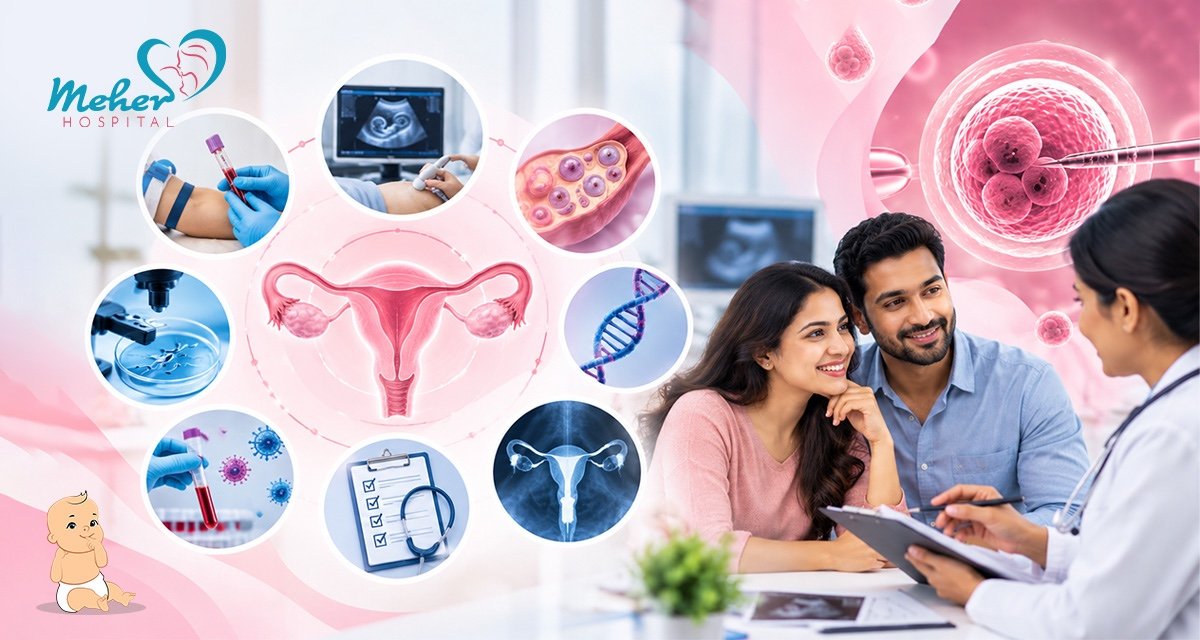
What Tests Are Done Before Starting IVF Treatment?
In Vitro Fertilization (IVF) is an expensive process that demands significant emotional and financial resources, which is why no reputable clinic will begin your treatment on the first day of your visit. Before even prescribing any stimulating medications, you need to undergo a series of tests that provide a full analysis of your reproductive system condition. These tests before IVF treatment aren’t just requirements; they define your individual stimulation protocol and medication dosage.
Why Pre-IVF Testing Matters?
Each infertile couple has an absolutely distinct underlying cause — and more often than not, it takes several small issues to combine to block fertility. Ovarian reserve, sperm characteristics, uterine cavity architecture, and hormonal balance all play a critical role in determining how an in vitro fertilization process should be approached. Not conducting this crucial pre-IVF testing usually results in a poor ovarian response or cycle cancellations, which otherwise could have easily been avoided by a proper diagnosis.
Comprehensive Fertility Tests Before IVF for the Female Partner
1. The Day 2 or 3 Hormonal Profile
Regarding the identification of the tests required before IVF, it is important to note that the tests for the female include a combination of very specific biochemical analyses and pelvic imaging:
The test is performed on the second or third day of active menstrual bleeding. It involves hormonal measurements:
- FSH (Follicle-stimulating Hormone) & LH (Luteinizing Hormone): These hormones demonstrate the level of activity of the pituitary gland that stimulates the ovaries.
- Estradiol: Estrogen hormone level that shows whether the ovaries are at rest and ready to be stimulated.
- Prolactin: High levels of this hormone may prevent ovulation and implantation of the embryo.
2. Ovarian Reserve Assessment
One of the most important tests that must be done before undergoing IVF involves quantifying and qualifying the eggs that you have left. These include:
- AMH (Anti-Müllerian Hormone) Test: A simple blood test that can be done any time of the month. This is a hormone produced by the granulosa cells inside the ovarian follicles and is the best way to gauge your ovarian reserve and how you will respond to stimulation medications.
- Antral Follicle Count (AFC): A high-resolution transvaginal ultrasound done during the early follicular phase. This gives the gynecologist the chance to see the follicles on your ovaries and quantify them through direct physical visualization.
3. Thyroid and Metabolic Screening
Reproductive health and hormones have a close relationship. Key markers to be assessed through blood work include TSH, T3, T4, and fasting blood sugar. There could be an undiagnosed thyroid condition, insulin resistance, or some other metabolic disorder that can negatively impact egg quality, embryo implantation, and result in miscarriage.
4. Detailed Uterine Cavity Evaluation
Even an entirely healthy embryo conceived in a laboratory can fail to attach if there are any structural abnormalities in the uterine lining. The testing of the uterus is done through the use of pelvic ultrasound, saline infusion sonohysterography (SIS), or hysteroscopy. Testing is done for the following issues:
- Uterine fibroids or polyps: Benign tumours that obstruct the uterine lining.
- Intrauterine adhesions: Scar tissue formed because of previous surgery or infections.
- Congenital septa: Structural abnormalities in the shape of the uterus limiting blood flow.
5. Tubal and Pelvic Health Screening
An HSG or laparoscopy is performed where clinically indicated. Though the process of in vitro fertilization does not involve the fallopian tubes at all, it is important to rule out a condition known as hydrosalpinx (fluid-filled fallopian tubes). The toxic fluid in such a tube can leak back into the uterine cavity, lowering the chances of embryo implantation by 50%.
6. Systemic and Infectious Disease Screenings
Mandatory screening requires testing both partners for HIV, Hepatitis B, Hepatitis C, and VDRL (Syphilis). Documenting these cleared test results is necessary to ensure that the clinical environment remains infection-free and that embryos are protected from cross-contamination during incubation in specialized laboratory incubators.
Specialized Diagnostics for the Male Partner
Fertility parameters are equally divided between men and women; thus, screening of all men is necessary:
1. Advanced Semen Analysis
Most vital in the screening process for a man. While basic testing at home does not provide complete information, advanced semen analysis measures the following factors:
- Sperm Count: The number of sperm in millilitres of semen.
- Sperm Motility: Proportion of sperm that shows vigorous forward movement.
- Sperm Morphology: Structure of the sperm. Irregularities in the head or tail could hinder fertilization.
- Viscosity and Seminal Volume: Physical qualities of seminal fluid.
In cases of severe male factor infertility, the embryologists will be in a position to prepare more advanced techniques such as Intracytoplasmic Sperm Injection (ICSI). This involves selecting one healthy sperm and injecting it into the mature egg. In cases of unexplained failure of fertilisation, a sperm DNA Fragmentation Index (DFI) test may be ordered.
2. Paternal Hormonal and Infection Screenings
Basal blood tests for FSH, total testosterone, and an infectious disease testing panel to match the panel for the woman counterpart.
What Happens After Testing?
After completion of these essential tests before IVF treatment, your fertility specialist reviews the comprehensive diagnostic profile data in order to create a highly individualized treatment plan. It includes the choice of the most suitable stimulation regimen (antagonists versus agonists).
Conclusion: Your Rightful Choice for a Successful Journey
Selecting the right place to start your infertility treatment is equally important as the treatment process itself. For those seeking to get treated in Uttarakhand, Meher IVF Fertility Centre is considered to be the best IVF hospital in Dehradun, Uttarakhand, and the best choice to make.
Right from the first consultation to all your diagnostic tests, you will be treated by the most competent team of expert gynecologists, pediatricians, and fertility specialists like Dr. Meenu Vaish and Dr. Mansi Vaish. With the use of innovative ICSI reproductive technology, 24-hour pathology laboratory services to test hormones instantly, and the first-ever 100-bedded NICU nursery in Dehradun, your healthcare journey will be designed with a complete evidence-based approach.
Schedule your consultation appointment now at Meher Hospital and begin your journey to parenthood with absolute clinical confidence.
Also read: Factors to Consider Before Making a Decision IVF Treatment Hospital in Dehradun
Meher Hospital is proudly powered by WordPress